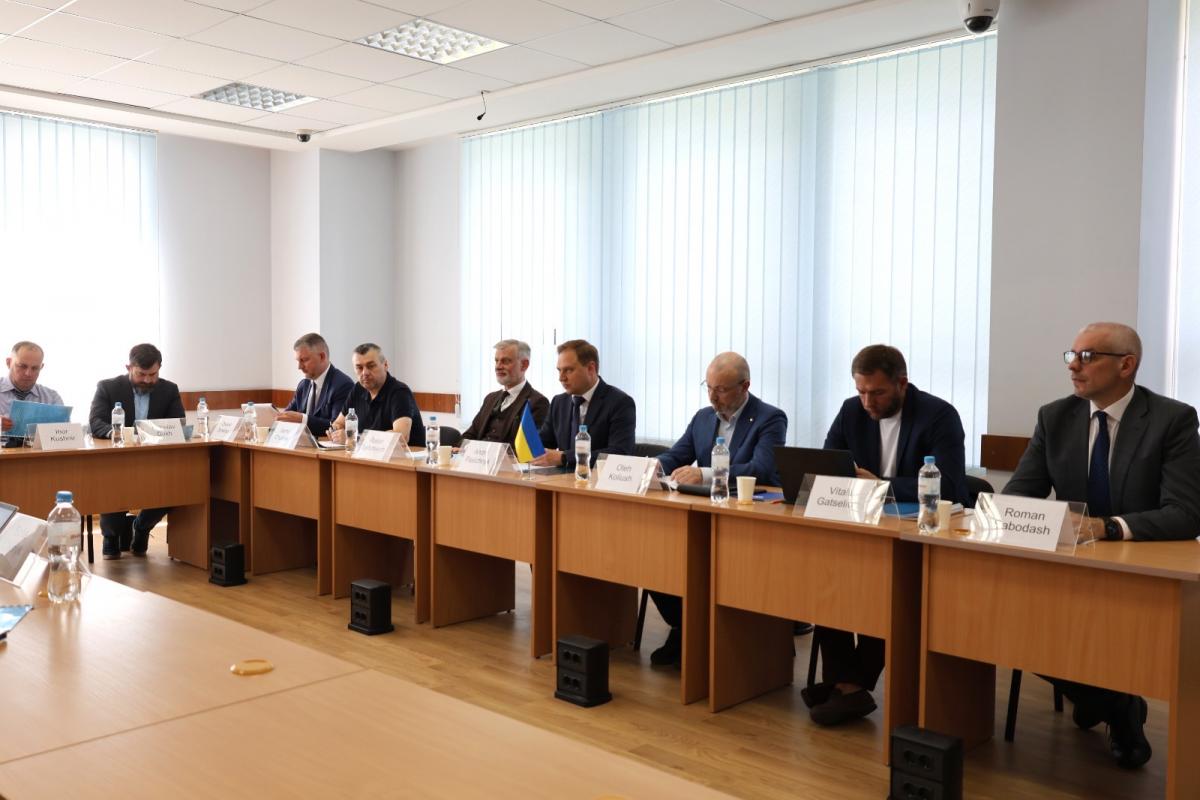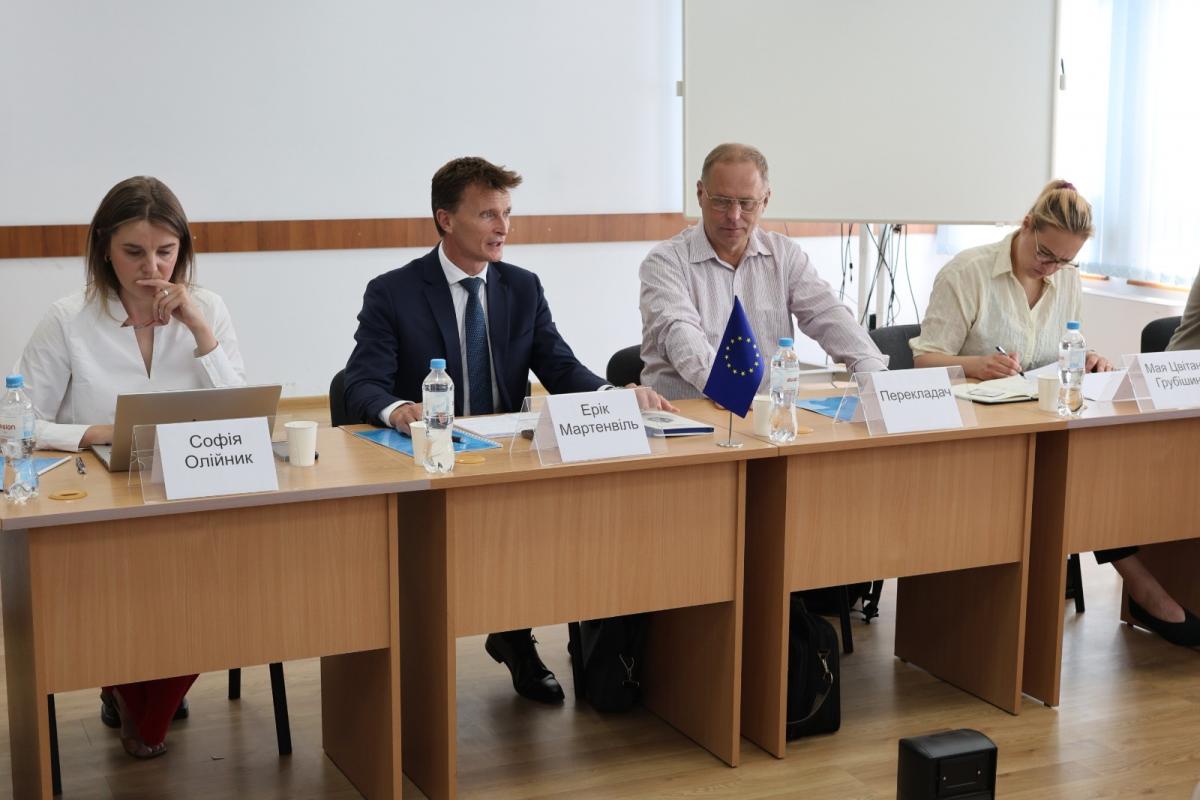

On July 09, 2026, the High Qualification Commission of Judges of Ukraine held a working meeting with representatives of the EU Project “PravoJustice4EU (Pravo 4)” and the French Agency for International Technical Assistance “Expertise France”. The parties discussed the outcomes of their previous cooperation, the Commission’s current needs, and areas for supporting justice sector reforms under the new phase of the Project.
The meeting was attended by Andrii Pasichnyk, the Chairman of the Commission; Oleh Koliush, the Deputy Chairman of the Commission; Commission members Vitalii Gatseliuk, Yaroslav Dukh, Oleksii Omelian, Roman Sabodash, Serhii Chumak and Ruslan Sydorovych; Taras Neshyk, the Deputy Head of the Commission’s Secretariat; and Yuliia Reminska, the Head of the International Cooperation Division of the Commission’s Secretariat.
The EU Project “PravoJustice4EU” was represented by Eric Martenville, the Team Leader, and Maja Cvitan Grubisin, the Lead of the “Justice Sector Reform Support” Component. Sofiia Oliinyk, the Country Director of Expertise France in Ukraine, also attended the meeting.
Welcoming the participants on behalf of the Commission, Andrii Pasichnyk noted that over the past three years, cooperation with the Project had covered key areas of the HQCJU’s activities, including improving selection procedures, competitions and qualification assessment procedures, developing digital and analytical tools, and strengthening the Commission’s institutional capacity. He emphasised that, under martial law and amid Ukraine’s European integration transformation, the Commission was undertaking an unprecedented scale of work.
“For the Commission, international support is of particular value when it translates into tangible institutional outcomes – a competition successfully conducted, the selection of candidates ensured, a digital tool developed, or a procedure improved. This practical focus characterised our cooperation with the Project in previous years”, the Chairman of the Commission said.
Among the most significant outcomes, the Chairman of the Commission highlighted support provided in organising the competition for vacant positions of judges in the courts of appeal. The competition, which had long been awaited by the judiciary and society, represented one of the key stages in addressing the shortage of judges in the courts of appeal. Its implementation required not only regulatory and organisational preparations, but also appropriate technical and material resources capable of supporting a large-scale, multi-stage procedure and ensuring equal conditions for all participants.
Another important area of cooperation was support for the selection of candidates for appointment as local court judges. This procedure is characterised by its considerable scale and the large number of participants involved. Its implementation required the Commission to address a range of organisational, technological and logistical challenges related to the administration of examinations, the processing of large volumes of information, and the co-ordination of the work of the relevant structural units.
Andrii Pasichnyk stressed that the Commission is currently carrying out a broad range of procedures provided for by the Law of Ukraine “On the Judiciary and the Status of Judges”, including the selection of candidates for the position of a judge, competitions for vacant positions of judges, qualification assessment and the transfer of judges. Given this workload, technical support can no longer be viewed merely as an auxiliary tool. It is an essential prerequisite for ensuring the continuity of the work of the judicial governance body.
The digitalisation of the activities of the High Qualification Commission of Judges of Ukraine has also become a strategic area of cooperation. The Commission is currently completing the implementation of software modules for collecting, systematising and analysing information required, in particular, for conducting special background checks of candidates for the position of a judge. As part of this procedure, the Commission interacts with nearly ten state registers and information systems. Manually processing information relating to a single candidate may take up to two working days, while data concerning several thousand individuals are subject to verification. The introduction of digital tools will significantly reduce the volume of manual work, accelerate information processing and improve its accuracy.
The software developed with the support of the Project will enable the automation of certain stages of information retrieval and processing, reduce the time required to conduct special background checks, standardise workflows and enhance the analytical capacity of the Commission’s Secretariat.
Sofiia Oliinyk, the Country Director of Expertise France in Ukraine, noted that the fourth phase of the EU Project “PravoJustice4EU” envisages systematic support for Ukraine over the next four years. The Project has a total budget of EUR 21 million. She emphasised that the launch of the new phase coincides with an important stage in Ukraine’s European integration process. In this context, strengthening an independent, effective and institutionally capable judiciary is one of the key areas of work under the “Fundamentals of the EU Accession Process” cluster.
During the meeting, representatives of the Commission also met Eric Martenville, the new Team Leader of the EU Project “PravoJustice4EU”, who has extensive professional experience in the justice sector, the implementation of international technical assistance programmes and expert support for reforms in EU candidate countries.
Eric Martenville stressed that the change in the Project’s name under its new phase to “PravoJustice4EU” was not accidental. According to him, it reflects the strengthened European integration dimension of the support and the focus of further cooperation on tasks related to preparing Ukraine for membership of the European Union. In this context, particular importance lies not only in continuing initiatives already launched, but also in aligning them with the current needs of Ukrainian institutions, European standards and Ukraine’s commitments under the accession negotiations.
The Team Leader also highlighted the importance of ensuring continuity between the Project’s phases, while noting that such continuity should not entail the mechanical replication of previous approaches.
“We should build on the experience of our previous cooperation and preserve what has proven effective, while at the same time being prepared to review approaches that require improvement. Our shared task is to find solutions that best respond to Ukraine’s needs and contribute to its continued progress towards membership of the European Union”, Mr Martenville said.
As a result of the meeting, the parties agreed to specify the areas of further cooperation. Priority will be given to implementing the measures set out in the Rule of Law Roadmap for which the HQCJU has been designated as the lead implementing institution.
The Commission expresses its gratitude to the team of the EU Project “Pravo-Justice III” for its consistent and substantive support over the previous years and confirms its readiness to jointly build on the results achieved under the new programming cycle of financial support, giving the partnership renewed substance in line with Ukraine’s objectives on its path towards membership of the European Union.